
Plumbing permits in Vancouver: who can apply and what it costs
You need a plumbing permit in Vancouver to move or add plumbing, and only a licensed plumbing contractor or an owner who lives there can get one. The owner route is limited to a home with one principal dwelling unit, and the 2026 fee starts at $282 for up to three fixtures.
By the Delwin Construction team Updated
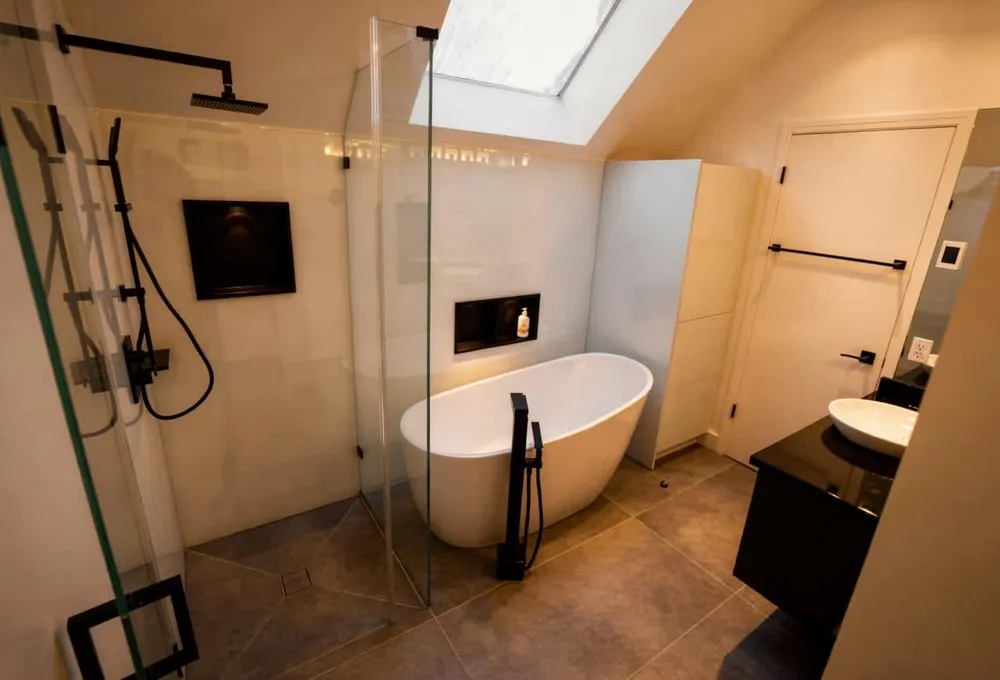
Moving or adding plumbing needs a City plumbing permit
The Vancouver Building By-law 2025 controls who may get a permit to build, extend or alter a plumbing system, and the City requires a permit before a renovation moves existing plumbing lines. That takes in a toilet shifted to another wall, a sink moved to an island in a kitchen renovation, and a fixture added where there was none.
The rule itself is in Division C of the by-law: the City issues plumbing permits only to licensed plumbing contractors. One exception for owners is set out in the next section. This page covers the City of Vancouver only; a home in a neighbouring Metro Vancouver municipality follows that municipality’s permit rules.
| Plumbing permit? | Who can apply | |
|---|---|---|
| Replace a sink, toilet or other fixture where it already is | No | Nobody: there is no permit to apply for |
| Move a sink, toilet or shower, or add a new fixture | Yes | A licensed plumbing contractor |
| The same work in a home you own and live in, in a building with one principal dwelling unit | Yes | You, as the owner-occupier, or a licensed plumbing contractor |
| The same work in a building with more than one principal dwelling unit | Yes | A licensed plumbing contractor only |
| Plumbing that serves more than one unit in a strata building | Yes, once the strata corporation approves it in writing | A licensed plumbing contractor |
A licensed plumbing contractor applies, or an owner who lives there
A plumbing permit in Vancouver goes to a licensed plumbing contractor unless you qualify for the owner exception. The by-law lets the owner of a residential building with not more than one principal dwelling unit take out a plumbing permit for it. The owner must also live there. If you’re not sure how the City counts the units in your building, ask before you plan the work around the owner route.
The fee counts fixtures, not the value of the job. Under the City’s 2026 fees, set in its November 2025 fee report:
- one, two or three fixtures cost $282 together;
- each fixture after the third adds $88.70.
Our guide to City of Vancouver building permit fees puts the plumbing permit beside the building and electrical permits in one worked example. Planning a bathroom renovation in Vancouver that moves the toilet or shower? Book a free on-site consultation to scope the work before anyone applies.
The City checks the applicant first and the work after
Before a plumbing permit is issued, the City checks that the applicant may hold one. That means a licensed plumbing contractor, or an owner who lives in a building with one principal dwelling unit. In a strata building, it also needs the strata corporation’s written approval when the work touches common property, and services that serve more than one unit count as common property. Our guide to strata approval for renovations explains how to get that letter.
Inspections follow, and a failed one costs money. Each reinspection made necessary by faulty work or materials, or by work that wasn’t ready when the inspection was booked, carries a 2026 fee of $282.
Plumbing updates qualify for the City’s one-week fast track
Kitchen and bathroom plumbing updates are on the eligible list for the Residential Renovation Fast Track, the City’s route for simple home renovations valued under $250,000. Permits on that route come within one week. A case that involves work already done without a permit is not eligible. For renovations outside the fast track, our guide to how long Vancouver renovation permits take uses the City’s own permit records.
Either way, the plumbing permit has to be in hand before any pipe moves.
Unpermitted plumbing stops the job, and the owner pays the penalty
When plumbing that needs a permit is moved without one, the City treats it as work without a permit. Everything on site stops while a permit is processed, and the City’s penalty is typically twice the original permit fee. Plumbing already installed may have to be taken out. Those costs land on the homeowner, including when the contractor promised that no permit was needed.
Replacing a fixture where it already is needs no permit
The City’s list of work that needs no permit includes replacing fixtures, cabinets and flooring. A new toilet or vanity in the spot the old one used falls under it, so a refresh that keeps the plumbing layout skips the permit and its fee. Our renovation permit guide for Vancouver sets this against the other common projects.
The owner exception has its own limit. It requires the owner to be the occupier, so an owner who rents the home out and lives elsewhere hires a licensed plumbing contractor for permitted work.
Questions people ask
Can a homeowner get a plumbing permit in Vancouver?
Yes, if you own the home, live in it, and the building has not more than one principal dwelling unit. That exception sits in Division C of the Vancouver Building By-law 2025, next to the general rule. Otherwise the City issues plumbing permits only to licensed plumbing contractors, so an owner who rents the home out and lives elsewhere can't take one out.
Do I need a permit to replace a toilet or vanity in the same place?
No. The City of Vancouver lists replacing fixtures, cabinets and flooring as work that needs no permit, so a new toilet or vanity where the old one stood is exempt. Move it to another wall, or add a second sink, and the job needs a plumbing permit, which in 2026 starts at $282 for up to three fixtures.
How much is a plumbing permit in Vancouver?
The City's 2026 fees charge $282 to install one, two or three fixtures and $88.70 for each fixture after the third. If an inspection has to be repeated because of faulty or incomplete work, each reinspection costs $282. The amounts come from the fee report the City published in November 2025 for the year starting January 1, 2026.
Sources
- City of Vancouver: Vancouver Building By-law 2025 (By-law 14343), Book I, Division C, Articles 1.6.3.2 and 1.6.3.6
- City of Vancouver, Council report RTS 18094: 2026 Fee Increases for Rezoning, Development, Building, and Other Related Applications and Permits (Appendix A)
- City of Vancouver: When you need a permit
- City of Vancouver: Renovate a home
- City of Vancouver Bulletin 2003-014-AD: Permits for Strata Buildings